Operations & Supply Chain - The People Who Keep Production Moving
You are measured by flow.
Not in theory, in reality: line uptime, schedule adherence, release readiness, and whether product leaves the site exactly when it must. When everything works, nobody notices. When one thing fails, everyone suddenly needs answers immediately.
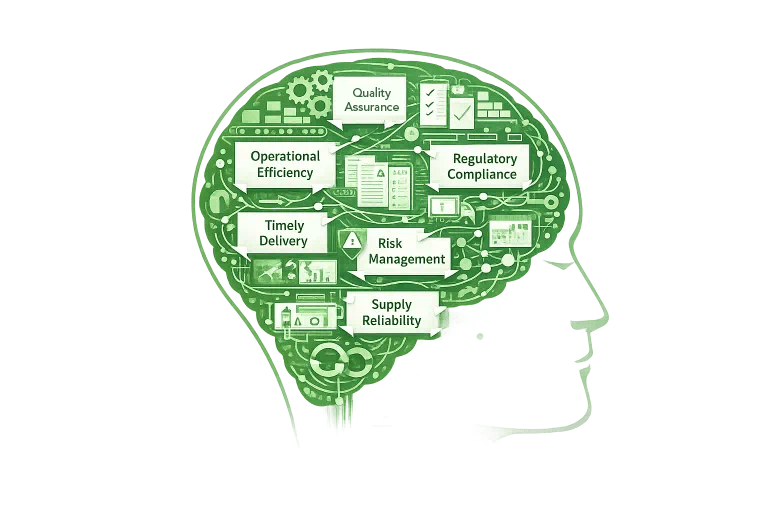
And what makes your role uniquely intense is that you’re running a system where small variability becomes big impact: a minor quality signal can cascade into line holds; a late component delivery can become a missed batch, one unexpected change can ripple across planning, validation, and training.
This is for the Operations and Supply Chain professionals who carry that weight every day.
Your goals and objectives (what you’re ultimately trying to achieve)
You’re not chasing perfection for its own sake. You’re building predictability in a world that constantly throws unpredictability at you.
Your goals typically include:
- Operational efficiency: maximize throughput and minimize downtime, so production stays stable and output is reliable.
- Quality assurance: maintain high standards and avoid deviations that trigger rework, holds, or investigations.
- Cost optimization: reduce waste, reduce scrap, and avoid expensive “emergency mode” (expedites, overtime, revalidation).
- Regulatory compliance: ensure processes, documentation, and controls stay inspection-ready, even while scaling or changing.
- Timely delivery: meet production schedules and supply commitments, because delays are rarely “just delays” - they become shortages, escalation, and reputational impact.
- Risk management: identify and mitigate risks before they become shutdowns or patient-impacting events.
- Innovation & continuous improvement: adopt process improvements and new technologies when they genuinely reduce risk and increase stability.
If someone says “just keep the line running,” you know that’s shorthand for: keep quality, compliance, and supply running, simultaneously.
Your challenges (the real-world friction you deal with)
You’re managing constraints that are structural, not “performance issues.”
These are the kinds of challenges that show up repeatedly:
- Equipment downtime: maintenance needs and unexpected failures that disrupt production schedules and consume capacity you didn’t plan to lose.
- Quality control pressure: maintaining consistent quality in high-volume manufacturing, while preventing deviations from turning into full investigations.
- Manufacturing variability: even when procedures are “the same,” variability happens - process drift, component variation, handling differences, and you’re expected to detect and control it early.
- Resource constraints: balancing labor, budget, and capacity while still meeting aggressive production goals.
- Regulatory landscape complexity: navigating requirements that demand precision, traceability, and strong documentation, often while the operation is scaling or changing.
- Supply chain management: securing reliable component supply and managing supplier variability so the line isn’t held hostage by external delays.
- Data analysis and trending: interpreting performance and quality data to catch issues early, without drowning in noise.
- Cross-functional coordination: aligning Ops, QA, QC, Engineering, Procurement, and suppliers on standards and decisions, fast.
You’re not just operating a line. You’re operating a network of dependencies.
Your fears (what you actively work to prevent)
Operations and Supply Chain professionals don’t fear “problems.” You fear the problems that stop the system.
The big ones tend to be:
- Production shutdowns / production halts: equipment failure, component shortages, or a quality signal that forces stoppages and creates weeks of catch-up you may never fully recover.
- Quality failures that trigger noncompliance: defective components or inconsistent performance that leads to deviations, investigations, or even recalls, consuming resources and eroding confidence.
- Regulatory sanctions: findings or actions driven by inadequate control, insufficient documentation, or unresolved process variability.
- Safety incidents: contamination risks or workplace injury scenarios that affect people, product, and operations, and escalate immediately.
- Reputation damage (internal and external): once stakeholders start believing the operation is unstable, every future disruption becomes harder to manage.
These fears aren’t hypothetical. They’re the reason you build buffers, enforce controls, push for supplier reliability, and insist on change discipline.
How we solve it: one accountable syringe system that reduces operational friction at the source
Here’s the operational truth: complexity is a risk factor. Every additional supplier interface adds variability, coordination effort, and delay potential. That’s why the West Synchrony™ S1 PFS System is designed to remove a major structural burden:
We provide the full syringe system from one accountable source - engineered and supplied as one integrated offering.
For Operations & Supply Chain, that creates tangible wins:
- Higher operational efficiency: fewer component mismatches, fewer incoming issues, fewer line interruptions tied to interface problems, supporting higher throughput and reduced downtime.
- Stronger quality assurance by design: fewer defects and more consistent system performance reduce deviation volume and investigation load, so your teams spend more time producing and less time firefighting.
- More reliable delivery and simpler planning: predictable supply from one accountable partner reduces the risk of production stops driven by missing or misaligned components, and helps you run leaner, smarter inventories.
- Improved efficiency in testing and release activities: less variability and clearer system control can reduce repeated troubleshooting, shorten “why is this happening?” cycles, and support smoother release readiness.
- Lower total operational complexity: fewer suppliers to manage, fewer change-control streams to reconcile, fewer emergency escalations when something shifts.
What this means in human terms:
- Fewer late-night escalations.
- Fewer “stop the line” moments caused by avoidable component-interface issues.
- More confidence that the plan you built is the plan you can execute.
Because your success is not a slide metric. It’s stability, and stability improves dramatically when the syringe is treated as one system—owned and supplied as one system.
Learn more about the West Synchrony S1 Prefillable Syringe (PFS) System.


 English
 Chinese