Drug Product Compatibility in Prefilled Syringes
Why barrier films matter for protecting sensitive injectable therapies
In prefilled syringes, drug containment risk does not end with sterility assurance. Even when a syringe maintains Container Closure Integrity (CCI) and performs mechanically as intended, direct contact between the drug product and elastomer components can introduce risk over time—particularly for sensitive biologics and advanced therapies.
As regulatory scrutiny intensifies under frameworks such as EU GMP Annex 1, drug product compatibility has become a critical consideration in safeguarding product stability, efficacy, and patient safety throughout the lifecycle of an injectable drug.
Where drug product compatibility risk arises
Throughout storage and use, a drug product remains in prolonged contact with syringe components. At this interface, several compatibility risks may emerge, including:
- Protein adsorption onto elastomer surfaces
- Aggregation or denaturation of sensitive molecules
- Migration of compounds from elastomer materials
- Particle formation that may compromise quality or safety
These risks are exacerbated for low‑dose, high‑potency biologics and viral vectors, where even small losses in active drug or subtle formulation changes can impact clinical performance.
Why this matters:Compatibility failures are not just formulation concerns—they can translate directly into dose inconsistency, reduced efficacy, and regulatory risk.
Barrier films and drug–component interaction
While elastomer components are not always required to include a laminated barrier, uncoated elastomers introduce avoidable interaction risk for many modern injectable drug products.
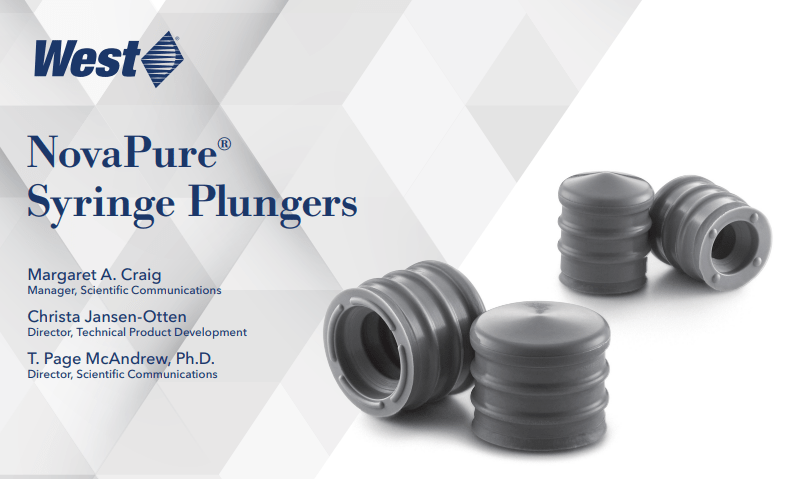
To mitigate this risk, NovaPure® syringe plungers incorporate a laminated barrier film on the elastomer surface that contacts the drug product, which is based on poly(ethene tetrafluoroethene) (ETFE)—a fluoropolymer widely used in pharmaceutical containment due to its:
- Very low surface energy
- Chemical inertness
- Compatibility with autoclave steam and gamma irradiation
- Established use in approved drug products
By lowering surface energy at the critical contact interface, the barrier film helps separate the drug product from the elastomer, reducing the likelihood of interaction.
Why this matters:Reduced surface interaction supports formulation stability across extended shelf life and helps maintain a consistent delivered dose.
Reducing interaction with biologic drug products
Biologic drug products are inherently vulnerable to surface‑driven interaction. Prolonged contact with elastomer surfaces can lead to:
- Adsorption of active protein
- Aggregation
- Reduced recovery of the intended dose
To evaluate this risk, West conducted studies using proteins as established proxies for biologics and viral vectors. Interaction was assessed using multiple indicators, including:
- Particle count following agitation
- Turbidity measurements
- Protein recovery after controlled exposure
Across all measures, laminated components showed lower levels of interaction than unlaminated components, indicating enhanced protection of the drug product.
Why this matters:Limiting adsorption and aggregation helps preserve potency, particularly for high‑value biologics where dose loss is unacceptable.
Mitigating the migration of compounds from elastomer components
In addition to surface interaction, elastomer components may pose risk through the migration of compounds into the drug product during storage.West evaluated this risk by comparing unlaminated elastomer components with fluoropolymer laminated components. After storage under controlled conditions, analysis was conducted using headspace gas chromatography with mass spectrometry.
The results showed:
- Numerous compounds remained present in systems using unlaminated components
- Virtually no detectable compounds in containment systems protected by fluoropolymer lamination
Why this matters:Reducing compound migration helps minimize contamination risk, chemical instability, and unintended changes to drug product composition.
Compatibility and drug containment risk management
Drug product compatibility is a core pillar of containment risk, alongside CCI and syringe performance.
By addressing both:
- Drug–component interaction, and
- Migration of elastomer‑derived compounds,
laminated barrier films help mitigate key failure modes that can otherwise compromise:
- Product stability
- Therapeutic efficacy
- Patient safety
- Regulatory confidence
Why this matters:For manufacturers of injectable biologics and sensitive therapies, compatibility‑focused component choices are a proactive step toward lifecycle risk reduction.
Learn more: managing drug product compatibility risk in syringe systemsThis blog highlights selected findings from Chapter 4 of the NovaPure® Syringe Plungers eBook, which focuses on drug product compatibility as a critical influence on drug containment risk.
For a concise, decision focused overview, download the Chapter 4 information sheet, which summarises:
- Key drug product compatibility risks
- How component lamination reduces interaction and migration
- Why West’s fluoropolymer barrier film matters for sensitive injectable drugs
Download the Chapter 4 Info Sheet
For full experimental details and additional context on syringe design and performance, access the complete NovaPure® Syringe Plungers eBook.Download the NovaPure Syringe Plungers eBook


 English
 Chinese