How to Choose Parenteral Packaging: A Practical Guide to Vials, Prefillable Syringes, and Cartridges
In parenteral drug development, packaging is often discussed as a format decision based on containment in vials, prefillable syringes, or cartridges. In reality, packaging choices involve far more than the container itself. Packaging influences product stability, manufacturing complexity, patient experience, and long-term lifecycle performance.
For teams entering the parenteral packaging space, the goal should not be to simply identify a “best” option. However, the goal should be to select the format that best aligns with the drug product’s characteristics, the intended patient population, and the development strategy.
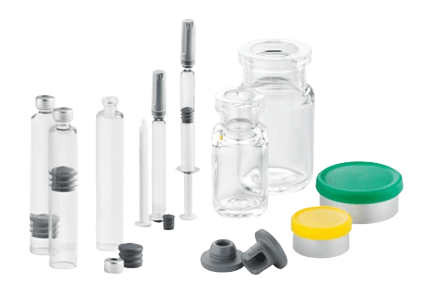
Understanding how each format supports different priorities allows teams to make informed decisions early, before flexibility narrows and tradeoffs become constraints.
What Drives the Choice?
Packaging selection is rarely driven by a single factor. Instead, it reflects a balance of considerations that evolve throughout development.
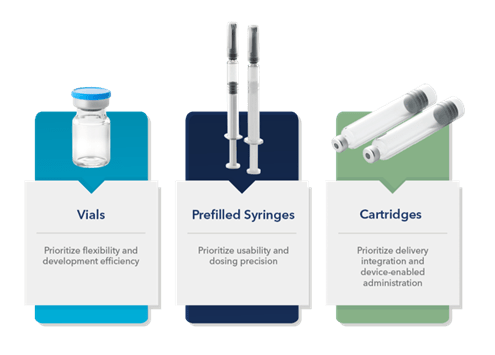
Common influences include:
Early decisions can create flexibility – or quietly limit it. Recognizing what each format is designed to support helps ensure alignment from the start.
Vials: When Flexibility is the Priority
Vials remain one of the most widely used formats in parenteral development, particularly in early stages.
From a development perspective, vials offer adaptability. They are compatible with a broad range of drug product formulations, dosing strategies, and fill finish operations. This versatility makes them well suited for programs where requirements may still be evolving. This makes them particularly valuable during early clinical phases, where adaptability can accelerate learning.
Their familiarity across industry and regulatory environments also simplifies alignment and communication, particularity during clinical development.
However, vials typically require preparation prior to administration, such as withdrawing the drug into a syringe. This introduces additional handling steps and may reduce convenience.
Prefillable Syringes: When Usability and Precision Matter
Prefillable syringes move the drug closer to the point of administration. Because they function as both a container and drug delivery system, they can reduce preparation steps and support ready to use intended applications.
This makes them particularly well aligned with chronic therapies and self-administered products, where ease of use and consistency are central to patient experience.
At the same time, prefillable syringes introduce tighter system requirements. Prolonged contact between the drug and container materials increases the importance of compatibility, surface interactions, and system integrity.
Prefillable syringes are typically selected when usability, dosing precision, and patient experience are key drivers.
Cartridges: When Delivery Integration is Central
Cartridges are most commonly paired with pen or auto injectors and are designed to integrate directly with a delivery device.
For therapies where controlled dosing, adherence, and device enabled administration are central to success, cartridges provide a strong foundation. In these systems, packaging and delivery strategies are inseparable.
That integration also introduces complexity. Cartridges require early alignment between the drug product, container, and device. Changes later in development can have broader downstream impact compared to more flexible formats that prioritize adaptability.
Cartridges are often selected when delivery strategy defines the program and when device integration is a core component of the product’s value.
Matching the Format to the Program
Each packaging format supports different priorities:
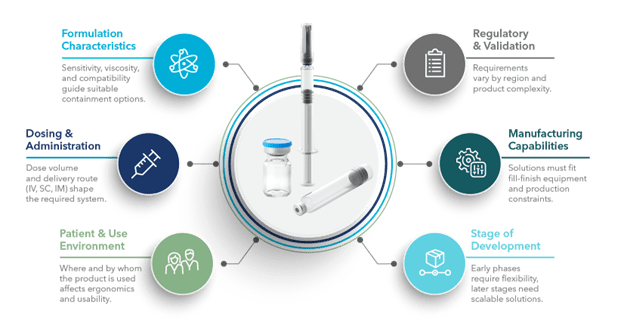
No format is inherently superior. The best choice depends on where the drug product is today and ultimately where it is intended to go.
When packaging is evaluated through this lens, discussions shift from preference to alignment. Teams can weigh tradeoffs deliberately rather than reactively, reducing risk and supporting smoother progression through development to commercialization timelines.
Moving Forward with Confidence
Packaging format decisions influence far more than container selection. They shape stability strategies, manufacturing approaches, validation pathways, and patient experience.
For organizations new to parenteral development or entering more complex therapies, clarity around these tradeoffs strengthens early decision making and minimizes the potential for downstream rework.
This is where scientific partnership becomes essential. At West, our Technical Customer Support (TCS) team partners with customers to interpret tradeoffs, anticipate downstream impacts, and guide packaging decisions that support both immediate development milestones and long-term lifecycle strategy. Get in touch with us here to start the conversation.
Grounded in more than a century of experience, we bring an end-to-end perspective to parenteral packaging – connecting materials, components, and process considerations to support confident decision making across development and commercialization.
Stay Tuned
In the next installment, we will look inside parenteral packaging systems, exploring component materials, and key considerations that further influence performance over the lifecycle of a drug product.
To read part one, An Introduction to Parenteral Packaging: The Backbone of Safe and Effective Injectable Drug Delivery, please click here.


 English
 Chinese