The People Who Turn an Idea into a Deliverable Product
In device and packaging development, you live in the space between “possible” and “proven”.
Everyone around you expects certainty: clear timelines, stable specifications, predictable performance. But for the drug or device engineer, you’re building that certainty in real time, while requirements evolve, data accumulates, and constraints tighten. And you’re doing it with one non-negotiable endpoint: a product that works safely, reliably, and compliantly - at scale.
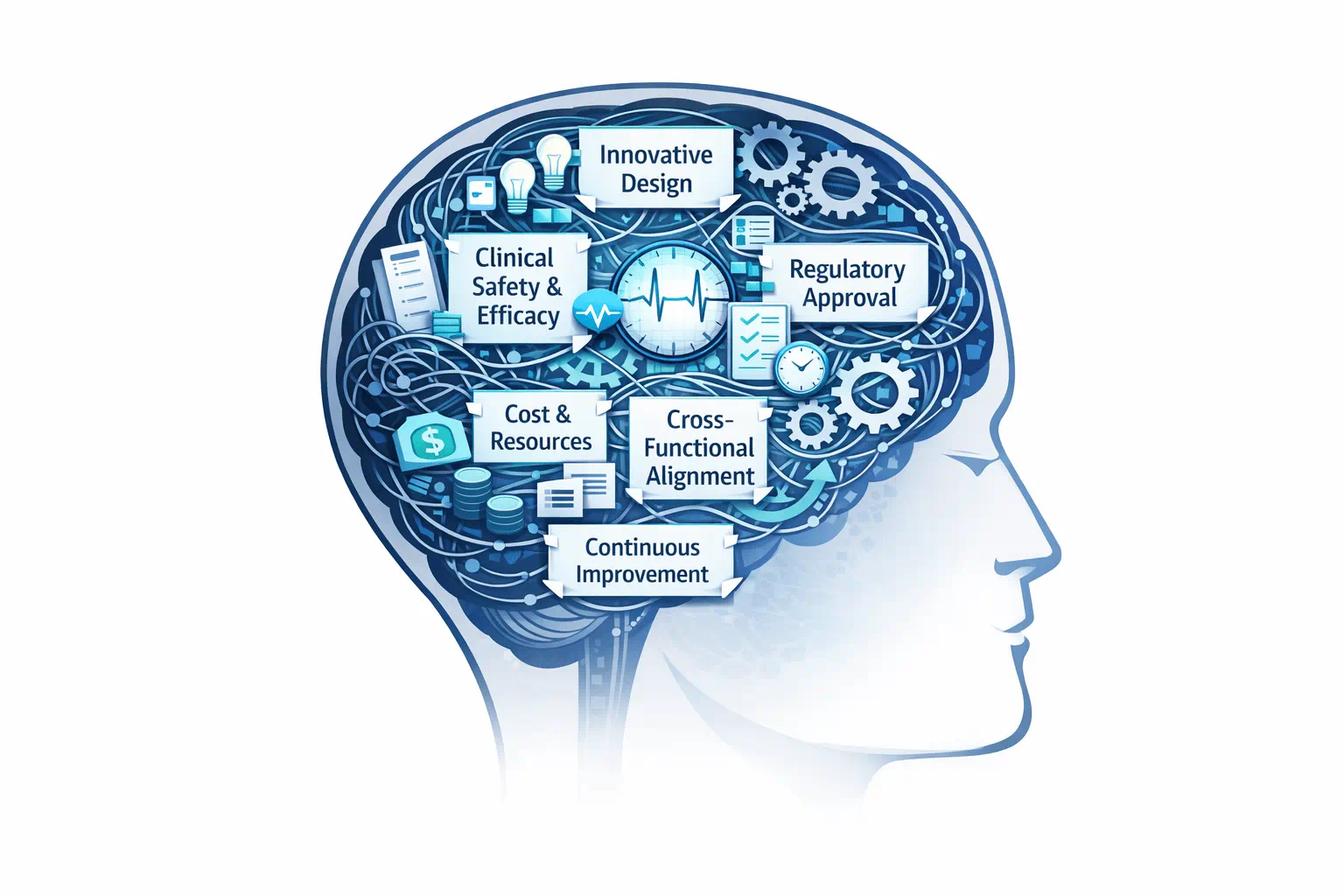
Sound familiar? If so, this blog post is for you, whether your day starts with formulation discussions and clinical strategy, or with device requirements and design reviews. The focus may be different, but the pressure is the same. The priorities across all drug development and device engineering functions seem to center around the same themes.
- Innovative development and design: Creating a drug + delivery approach that is effective, user-friendly, and technically viable, without designing yourself into a corner.
- Clinical efficacy and safety: Ensuring performance is consistent and safe in real-world use, not just in a controlled lab environment.
- Regulatory approval: Building an evidence-backed story that stands up to scrutiny - requirements, risk management, verification/validation, and traceability.
- Time-to-market: Move fast enough to stay competitive and meet patient needs, without triggering late-stage rework.
- Cost and resource discipline: Keeping development efficient and realistic, especially when budgets and capacity are under pressure.
- Cross-functional collaboration: Align drug product, device, quality, regulatory, operations, and suppliers into one coherent development path.
- Continuous improvement: Learn, iterate, and optimize, without burning time and credibility on avoidable iteration loops.
We know that progress is never linear. The reality is that the same roadblocks and complexities that may be plaguing your program are consistent across industry. Development is rarely blocked by one big problem. It’s blocked by many interconnected ones.
Complex R&D processes
You are managing intricate workflows across formulation, analytics, device performance, stability, manufacturability, and usability. It’s a lot to juggle while keeping the program cohesive.
Additionally, when it comes to device development, translating complex design requirements into engineering reality, ensuring compatibility of components, and managing constraints like standards, budgets, and project timelines can be a struggle. Not to mention new methods, new device requirements, and evolving platform expectations.
Regulatory requirements
Requirements are stringent, and the volume of evidence needed (and the way it must connect) can grow quickly.
Resource constraints
Time, people, and lab capacity are always finite, and you often have to decide what data is “must-have now” vs “must-have later.” Budgets are always tight, and a critical factor in gaining funding is adhering to timelines and reaching milestones. Your program depends on alignment between multiple disciplines, often with their own priorities and timelines.
Interdisciplinary coordination
One of the most frustrating patterns is when progress is slowed not by science, but by interface complexity: multiple components, multiple suppliers, multiple ownership boundaries.
Your fears as a drug developer or device engineer
Experience teaches you that the most damaging setbacks are often discovered late, when change is hardest and most expensive.
- Clinical trial failure: not necessarily because the molecule isn’t promising, but because avoidable issues (delivery performance, variability, usability, compatibility) undermine outcomes or confidence.
- Regulatory delays and missed milestones: a late-stage question, deficiency, or additional data requirement that pushes timelines, drains resources, and triggers rework.
- Design flaws discovered too late: critical design weaknesses or performance gaps that appear after key decisions have been locked, creating major redesign or remediation cycles.
- Market/competitive consequences: delays that allow competitors to leapfrog, or a device/drug combination perceived as unreliable or hard to use.
- IP and security risks (device-focused): concerns around intellectual property, and even cybersecurity where applicable for connected delivery solutions.
Underneath all of these is the same underlying concern: a preventable complexity becomes a program-defining event.
How we solve it: a true, prefillable syringe system - one accountable source, fewer iterations, faster confidence
Development moves fastest when you remove unnecessary variables. That is exactly what a complete prefillable syringe system from one accountable source enables.
When glass barrel, needle, needle shield/tip cap, and plunger come as one integrated system, you reduce the friction that typically forces redesign loops and consumes validation bandwidth.
- Fewer design iterations: A system-level approach reduces component-interface mismatch risk and the iterative troubleshooting that comes with fragmented sourcing.
- Higher reliability and a cleaner development story: When the delivery system is designed, released and delivered as a system, you gain more consistent performance, and a more coherent evidence package to support decisions.
- Faster progress through validation and verification: Reduced uncertainty and clear ownership can lower the “investigation tax” and help you move through verification and validation with fewer surprises.
- Better compatibility for innovation: You can pursue advanced delivery approaches with a stronger foundation, because the core prefillable syringe system is designed to be compatible and reliable, not assembled from disconnected parts.
Development is hard enough when you’re solving the right problems - molecule performance, patient needs, clinical and regulatory strategy. You shouldn’t have to spend your best energy solving the avoidable ones - like fragmented accountability across prefillable syringe components.
An integrated, verified prefillable syringe system from one accountable source is a structural simplifier. And in Development, simplification is not “nice to have.” It is often the difference between iteration and momentum.
To learn more about how West is addressing development risk for drug and device engineers, visit West Synchrony™: Prefillable Syringe System.


 English
 Chinese