Distinguishing Silicone Oil Particles: Implications for Drug Products
Silicone oil is commonly applied to components involved in primary drug containment, primarily serving as a lubricant for elastomeric parts. For instance, silicone oil is commonly applied to rubber stoppers and plungers to facilitate machinability throughout the fill-finish process. Similarly, it is used on the inner surface of syringes to enable smooth and controlled movement of the piston during injection. However, silicone oil introduced into the primary container may migrate into the drug product, where it can appear as sub-visible particulate matter—an important critical quality attribute (CQA) of the final drug product.
The U.S. Pharmacopeia (USP) recently published a Stimuli article titled “Addressing Subvisible Silicone Oil Droplets—Industry Challenges, Analytical Strategies, and USP’s Rationale for a New General Informational Chapter.” The article highlights the industry’s ongoing challenge of distinguishing silicone oil particles (SiOP) from other sources of subvisible particulate matter. Current testing outlined in USP <788> does not readily allow for differentiation between SiOP and other subvisible particles.
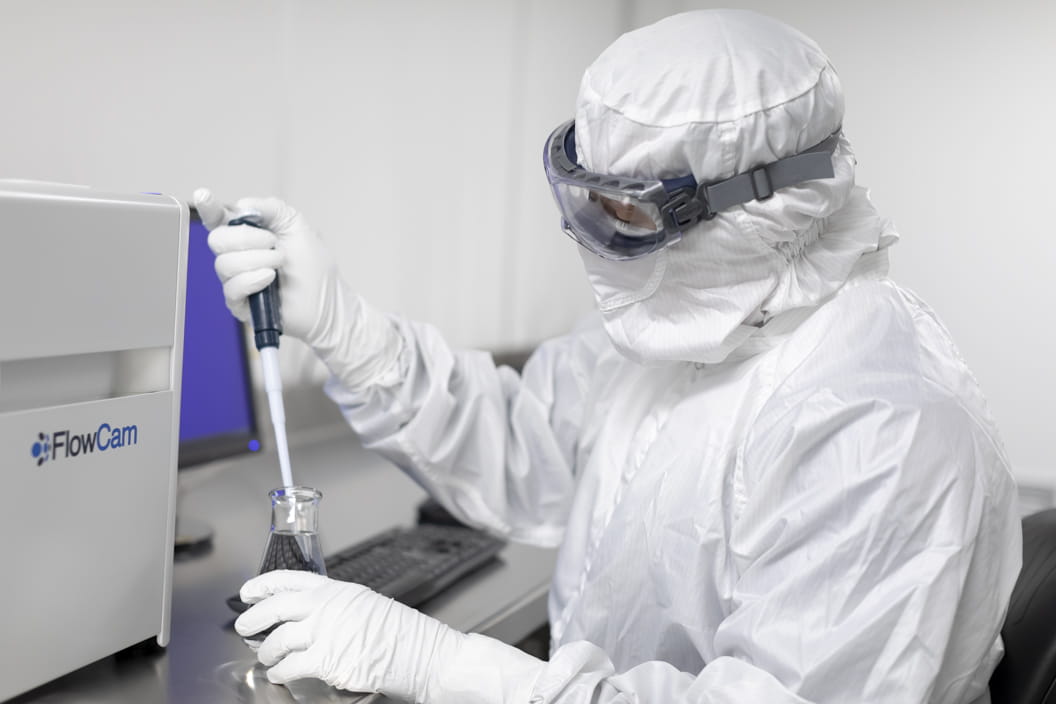
To address this limitation, advanced analytical approaches such as Fluid Imaging can be employed. This technique captures digital images of subvisible particles as they pass through a flow cell, enabling visual differentiation between silicone oil and non-silicone particles.
“The benefit of digital image capture is that it allows for quantitative and qualitative capture of particulate matter as opposed to the traditional quantitative-only capture in light obscuration methods,” explains Tyler Fields, a scientist who works in a GMP certified lab at a West facility
Additionally, orthogonal characterization tools—such as holographic microscopy—can be implemented during drug development, offering high-throughput analysis of small-volume samples.
As manufacturers transition from vial formats to prefilled syringes (PFS) in later phases of clinical development, the introduction of siliconized components may lead to an increase in the concentration of SiOPs within the subvisible particle population. This, in turn, can result in overall subvisible particle counts exceeding the limits specified in USP <788>. It is important to note that such increases do not necessarily indicate a loss of process control but instead reflect changes associated with the product’s containment and delivery system.
Silicone also presents the potential to interact with complex biomolecules such as proteins potentially leading to immunogenicity risk; although, there is currently no evidence indicating that SiOPs themselves directly cause immunogenic responses.
“It is essential to distinguish silicone particulates from protein aggregates, as confusing the two can mask formulation stability issues and increase patient safety risks, including unwanted immune system activation,” shares Rajiv Kumar, Senior Manager, Gene Delivery and Analytical Chemistry, West R&D.
Considering this, the USP Stimuli article proposes the development of an informational chapter that provides guidance on SiOPs, including a framework for what such a chapter might encompass. The article further emphasizes that, in addition to monitoring the count and size distribution of subvisible particles related to SiOPs, it is equally important to quantify the overall concentration of silicone oil in the drug product—typically expressed in parts per million (ppm). Analytical techniques such as inductively coupled plasma mass spectrometry (ICP-MS) can be employed for this purpose. Ultimately, the article underscores the importance of minimizing all forms of particulate matter through careful component selection and process control.
If monitoring silicone oil is a concern for your drug product, consider West Services and Solutions, LLC, which offers a GMP lab certified to ISO 9001:2008 and ISO 15378:2001. The lab is equipped with FlowCam 8100, capable of performing sub-visible particle testing according to UPS <1788.3>. To read more about fluid imaging, click here.
West Services and Solutions, LLC is a wholly owned subsidiary of West Pharmaceutical Services, Inc.
Top 3 Takeaways:
- Minimize particulate matter: Careful component selection is particularly important for sensitive biologics
- Distinguish SiOPs: This is a critical consideration, especially when transitioning from vial format to a siliconized PFS (may lead to an increase in overall sub-visible particle concentration)
- Utilize fluid-imaging instrumentation: Allows for characterization of sub-visible particles, and SiOPs can be identified from other types of particulate


 English
 Chinese